Use Less Plastic from TakePart on Vimeo.
Monday, June 7, 2010
Saturday, June 5, 2010
Facebook Fan Page for Life Less Plastic
Dear Readers,
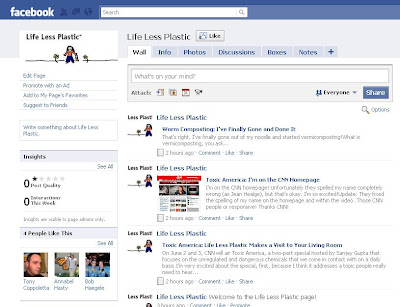
I've finally created a Facebook fan page for Life Less Plastic!
The page will serve as another venue for learning about and discussing the idea of using less plastic.
If you get the chance, please become a fan today! And don't forget to tell your friends!
Sincerely,
Jeanne
I've finally created a Facebook fan page for Life Less Plastic!
The page will serve as another venue for learning about and discussing the idea of using less plastic.
If you get the chance, please become a fan today! And don't forget to tell your friends!
Sincerely,
Jeanne
Labels:
facebook,
plastic,
use less plastic
Thursday, June 3, 2010
Worm Composting: I've Finally Gone and Done It
That's right. I've finally gone out of my noodle and started vermicomposting!
What is vermicomposting, you ask? According to wormwoman.com it is "a system for turning food waste into potting soil with the help of worms."
I know it sounds a little crazy, but indoor worm composting means producing less waste and using fewer plastic garbage bags--two things I really want to do to help the environment. For apartment dwellers, it may also be less likely to annoy your landlord than other composting methods, like the compost tumbler I tried to use, since he or she will probably never know about it.
To create my bin, I bought a few used, plastic bins off of Craigslist and used the following great instructional video by the Compost Guy.
After creating my bin, I started collecting my food scraps in a cut-off milk carton and storing them in the freezer. I also put in an online order for some red wiggler worms to the Compost Guy, the creator of the video.
The worms arrived to my office several days later (my apolgoies to our receptionist!).
When I opened the box, I was happy to see that they were still alive and wriggling around, despite spending a few extra days at the post office due to the rather strange workings of the Chicago postal service.
Once I got my worms home, I added my food scraps to my recently created bin, dumped in the worms, and closed up the bin (all according to the instructions, of course).
And that's it. Now I've got an active vermicomposter that is turning my food waste into soil. It's amazing.
And so far it doesn't smell or have any fruit flies, although, on occasion, it probably will in the future. But that's okay. There is tons of information on the internet on maintaining and troubleshooting worm bins, and working through the problems will be well worth it in the end.
For now though, everything is perfect, and I'm hoping it stays that way, at least for a little while!
(Note: For the small amount of garbage I produce, I use Seventh Generation bags made from 55% recycled plastic).
What is vermicomposting, you ask? According to wormwoman.com it is "a system for turning food waste into potting soil with the help of worms."
I know it sounds a little crazy, but indoor worm composting means producing less waste and using fewer plastic garbage bags--two things I really want to do to help the environment. For apartment dwellers, it may also be less likely to annoy your landlord than other composting methods, like the compost tumbler I tried to use, since he or she will probably never know about it.
To create my bin, I bought a few used, plastic bins off of Craigslist and used the following great instructional video by the Compost Guy.
After creating my bin, I started collecting my food scraps in a cut-off milk carton and storing them in the freezer. I also put in an online order for some red wiggler worms to the Compost Guy, the creator of the video.
The worms arrived to my office several days later (my apolgoies to our receptionist!).
When I opened the box, I was happy to see that they were still alive and wriggling around, despite spending a few extra days at the post office due to the rather strange workings of the Chicago postal service.
Once I got my worms home, I added my food scraps to my recently created bin, dumped in the worms, and closed up the bin (all according to the instructions, of course).
And that's it. Now I've got an active vermicomposter that is turning my food waste into soil. It's amazing.
And so far it doesn't smell or have any fruit flies, although, on occasion, it probably will in the future. But that's okay. There is tons of information on the internet on maintaining and troubleshooting worm bins, and working through the problems will be well worth it in the end.
For now though, everything is perfect, and I'm hoping it stays that way, at least for a little while!
(Note: For the small amount of garbage I produce, I use Seventh Generation bags made from 55% recycled plastic).
Labels:
compost,
composting,
plastic,
use less plastic
Wednesday, June 2, 2010
Toxic America: I'm on the CNN Homepage
I'm on the CNN homepage! Unfortunately they spelled my name completely wrong (as Jean Healge), but that's okay. I'm so excited!
Update: They fixed the spelling of my name on the homepage and within the video. Those CNN people or responsive! Thanks CNN!

Update: They fixed the spelling of my name on the homepage and within the video. Those CNN people or responsive! Thanks CNN!

Tuesday, June 1, 2010
Toxic America: Life Less Plastic Makes a Visit to Your Living Room
On June 2 and 3, CNN will air Toxic America, a two-part special hosted by Sanjay Gupta that focuses on the unregulated and dangerous chemicals that we come in contact with on a daily basis.
I'm very excited about the special, first, because I think it addresses a topic people really need to hear about and, second, because it is supposed to include a segment about me! Craziness!
As far as I know, the segment about my experiences giving up plastic is supposed to air on Thursday, June 3rd as part of the Toxic Childhood portion of the show. Please tune in!
I'm very excited about the special, first, because I think it addresses a topic people really need to hear about and, second, because it is supposed to include a segment about me! Craziness!
As far as I know, the segment about my experiences giving up plastic is supposed to air on Thursday, June 3rd as part of the Toxic Childhood portion of the show. Please tune in!
Labels:
chemical regulation,
chemicals,
news articles,
plastic,
use less plastic
Friday, May 28, 2010
Storing Vegetables Without Plastic in the Refrigerator
When I store veggies in the fridge, I typically just toss them on the shelf or put them in a glass container. Recently, though, I was wondering if there are better ways that would keep my veggies fresher. Lucky for me, Beth over at Fake Plastic Fish recently did a post on this. And just in time for farmers' market season.
The post links to an awesome little flyer done by the Berkeley Farmers' Market. It's called How To: Store Fruits and Vegetables: Tips and tricks to extend the life of your produce without plastic.
Enjoy!
p.s. This isn't in the brochure, but to store parsley or cilantro, I just put them in a glass of water (like flowers in a vase) and put them in the fridge. It's a plastic-free solution and it helps them keep for a long time.
The post links to an awesome little flyer done by the Berkeley Farmers' Market. It's called How To: Store Fruits and Vegetables: Tips and tricks to extend the life of your produce without plastic.
Enjoy!
p.s. This isn't in the brochure, but to store parsley or cilantro, I just put them in a glass of water (like flowers in a vase) and put them in the fridge. It's a plastic-free solution and it helps them keep for a long time.
Labels:
plastic,
plastic free,
use less plastic
Tuesday, May 25, 2010
In the News: Plastic Panic
There's an interesting article by Jerome Groopman in the most recent New Yorker. It's called Plastic Panic, and it focuses on the bisphenol A controversy, while also exploring why the effects of chemicals on the human body are so difficult difficult to determine.
In addition, it provides info on chemical legislation in the United States and demonstrates that the U.S. is in need of some serious reform.
Here are a few interesting bits from from the article on this subject:
Dear readers, I ask you to take a gander at this article so that you can get informed about this issue (if you're not already). It's an important one.
Related blog post : Better Chemical Regulation
In addition, it provides info on chemical legislation in the United States and demonstrates that the U.S. is in need of some serious reform.
Here are a few interesting bits from from the article on this subject:
- "The Toxic Substances Control Act, passed in 1976, does not require manufacturers to show that chemicals used in their products are safe before they go on the market; rather, the responsibility is placed on federal agencies, as well as on researchers in universities outside the government. The burden of proof is so onerous that bans on toxic chemicals can take years to achieve, and the government is often constrained from sharing information on specific products with the public, because manufacturers claim that such information is confidential."
- "According to the E.P.A., some eighty-two thousand chemicals are registered for use in commerce in the United States, with about seven hundred new chemicals introduced each year. In 1998, the E.P.A. found that, among chemicals produced in quantities of more than a million pounds per year, only seven per cent had undergone the full slate of basic toxicity studies."
Dear readers, I ask you to take a gander at this article so that you can get informed about this issue (if you're not already). It's an important one.
Related blog post : Better Chemical Regulation
Labels:
chemical regulation,
plastic,
use less plastic
Subscribe to:
Posts (Atom)